(044) 222 33 33


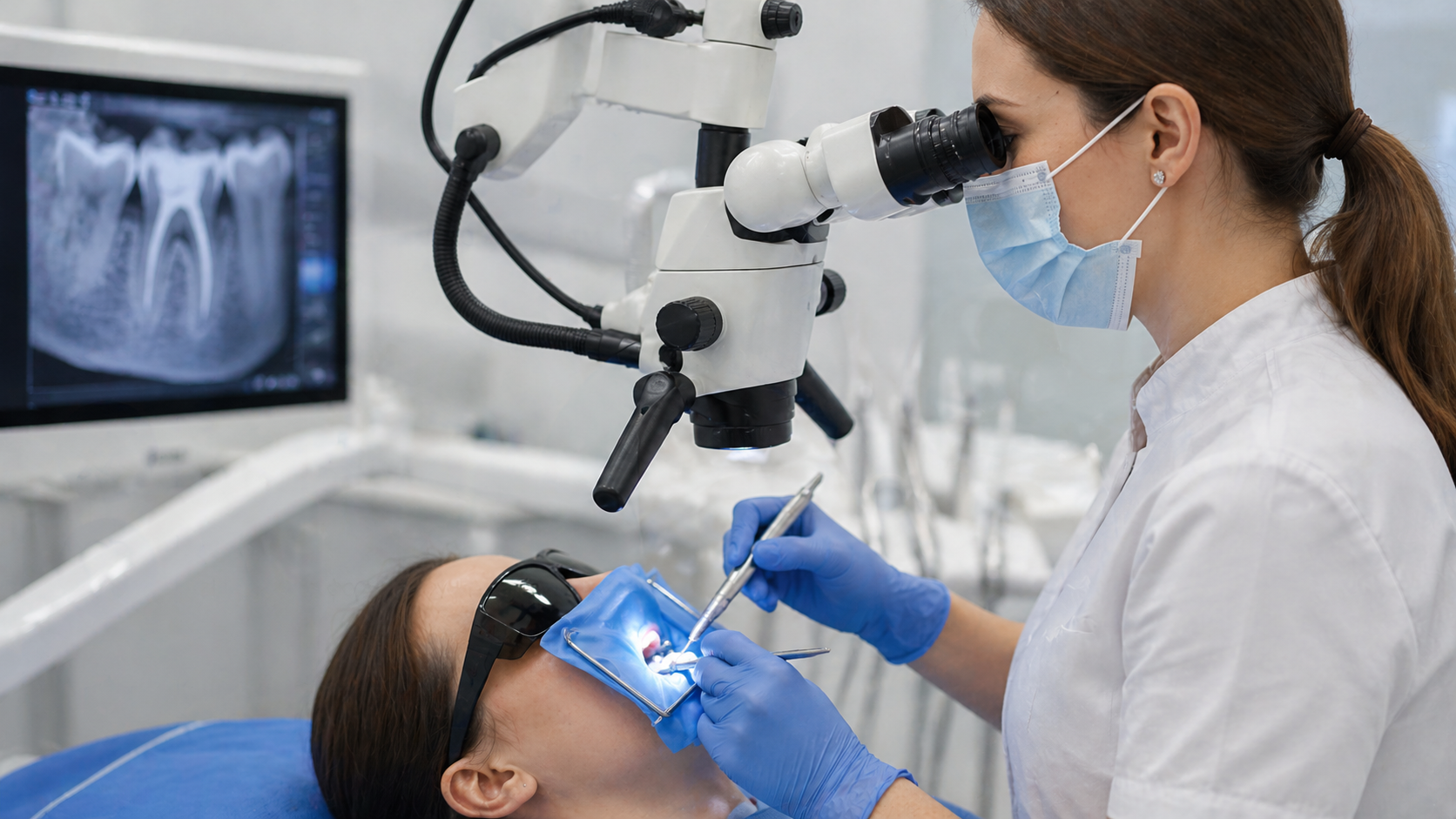

Endodontic treatment of the earlier treated canals package 1 canal (1st stage) with the microscope
What are the specific considerations for treating previously treated root canals?
Specific considerations for treating root canals undergoing retreatment may include:
- the need to remove old filling material: if substandard filling material was used during the initial treatment, retreatment may require its removal;
- the discovery of new or untreated root canals: during retreatment, it may be found that some root canals were not treated or were not detected during the initial treatment;
- the need for tooth restoration: retreatment of root canals may result in additional loss of tooth structure, which may require restoration of the tooth with a crown or other methods;
- identification of complex anatomical features: Root canal retreatment may require a more thorough examination of the tooth to identify complex anatomical features, such as curved root canals or irregular shapes;
- the need for more complex treatment techniques. If the initial treatment was ineffective, retreatment may require the use of more complex techniques and instruments to treat the root canals and eliminate the infection.
Why does the Astra Dent network use a microscope?
The microscope is one of the most important tools in modern dentistry, used to improve the precision and effectiveness of procedures. Here are a few reasons why a microscope is essential in dentistry:
- improved visibility: the microscope allows the dentist to magnify the image of the tooth and root canals, enabling them to identify problems more accurately and resolve them;
- Increased precision: A microscope allows the dentist to work with greater precision, as they can see a more detailed view of the tooth and root canals;
- root canal treatment: A microscope allows the dentist to better see and treat the root canals of teeth, which is especially important during endodontic treatment (root canal treatment);
- identifying problems invisible to the naked eye: The microscope allows the dentist to see fine details inside the tooth that are impossible to see during a routine examination.
What does the first stage involve?
For root canal retreatment, the first stage may include the following procedures:
- assessment of the tooth’s condition: an endodontist from the Astra Dent network must conduct a thorough examination of the tooth and assess its condition, including the presence of cavities, cracks, old fillings, root configuration, and other factors that may affect the effectiveness of treatment;
- X-ray examination: An X-ray can help identify potential issues with the root canals and ensure that all of the tooth’s root canals are treated;
- removal of old fillings and materials: If the tooth has been previously treated, it may be necessary to remove old fillings and other materials to start the treatment over;
- root canal cleaning: The root canals must be thoroughly cleaned of old material and bacteria. This may require the use of specialized instruments and techniques.
How is endodontic treatment performed on teeth that have already undergone root canal treatment?
Endodontic treatment on teeth that have already undergone root canal treatment typically proceeds as follows:
- tooth preparation: Before the procedure begins, the dentist administers anesthesia to numb the tooth. Then, the tooth and surrounding tissue are cleaned of bacteria and debris to create access to the root canal;
- assessment of the tooth and its canals: using X-ray equipment and a microscope, the dentist assesses the condition of the tooth and root canals. If necrotic tissue or infection is found in the canal, the canal is cleaned;
- root canal cleaning: Using special instruments, the dentist cleans the root canal of all necrotic tissue, infection, and bacteria. The canals may be enlarged to ensure the best access for instruments and materials;
- filling the canal: After thorough cleaning of the root canals, they are filled with a special material that prevents reinfection. Crowns may be used to strengthen the tooth and prevent it from breaking;
- completion of the procedure: After the canals are filled, the tooth is sealed with a temporary filling or a crown. Depending on the clinic and the situation, a follow-up visit may be required to complete the procedure.
In general, endodontic treatment of previously treated root canals can take anywhere from one to several sessions, depending on the complexity of the procedure and the overall condition of the tooth.
What determines the cost?
The cost of endodontic treatment for teeth that have already undergone root canal therapy may depend on several factors, such as:
- the location of the tooth: teeth in the front of the mouth are usually less expensive than those in the back, because they are easier to access for treatment;
- complexity of treatment: complex cases that require more time and materials may cost more;
- the exact cost can only be determined after a thorough examination of the tooth and an assessment of the treatment’s complexity by an endodontist.
Dentistry
Available in all dentistries
Service
Root canal treatmentCost of services
2750 UAH
Dentistry
Available in all dentistries
Service
Root canal treatmentCost of services
2750 UAH
Need a consultation?

Book a free consultation
Please submit your phone number, and we'll contact you to schedule a convenient time for your visit
Maryna
Coordinator
 info@astradent.ua
 Get a free consultation
-
 Open daily from 9 AM to 9 PM
 -
 No days off
 -
 Always powered